I’ll never forget the morning I knew something wasn’t right.
My breeding buck — strong, steady, the backbone of our herd — wasn’t meeting me at the gate. Instead, he stood off to the side, slightly hunched, shifting his weight like he couldn’t quite figure out where his back feet were supposed to go. At first it was subtle. A little wobble. A strange hesitation when he turned. By that evening, he was dragging a hind toe.
Last year, I lost him to meningeal worm — also known as deer worm — and it was one of the hardest losses we’ve faced on our farm.
Today I want to share what I learned, what this parasite actually is, and why even experienced veterinarians — including mine, who also serves as a vet at a local zoo — struggle to treat it in time.
What Is Meningeal Worm (Deer Worm)?
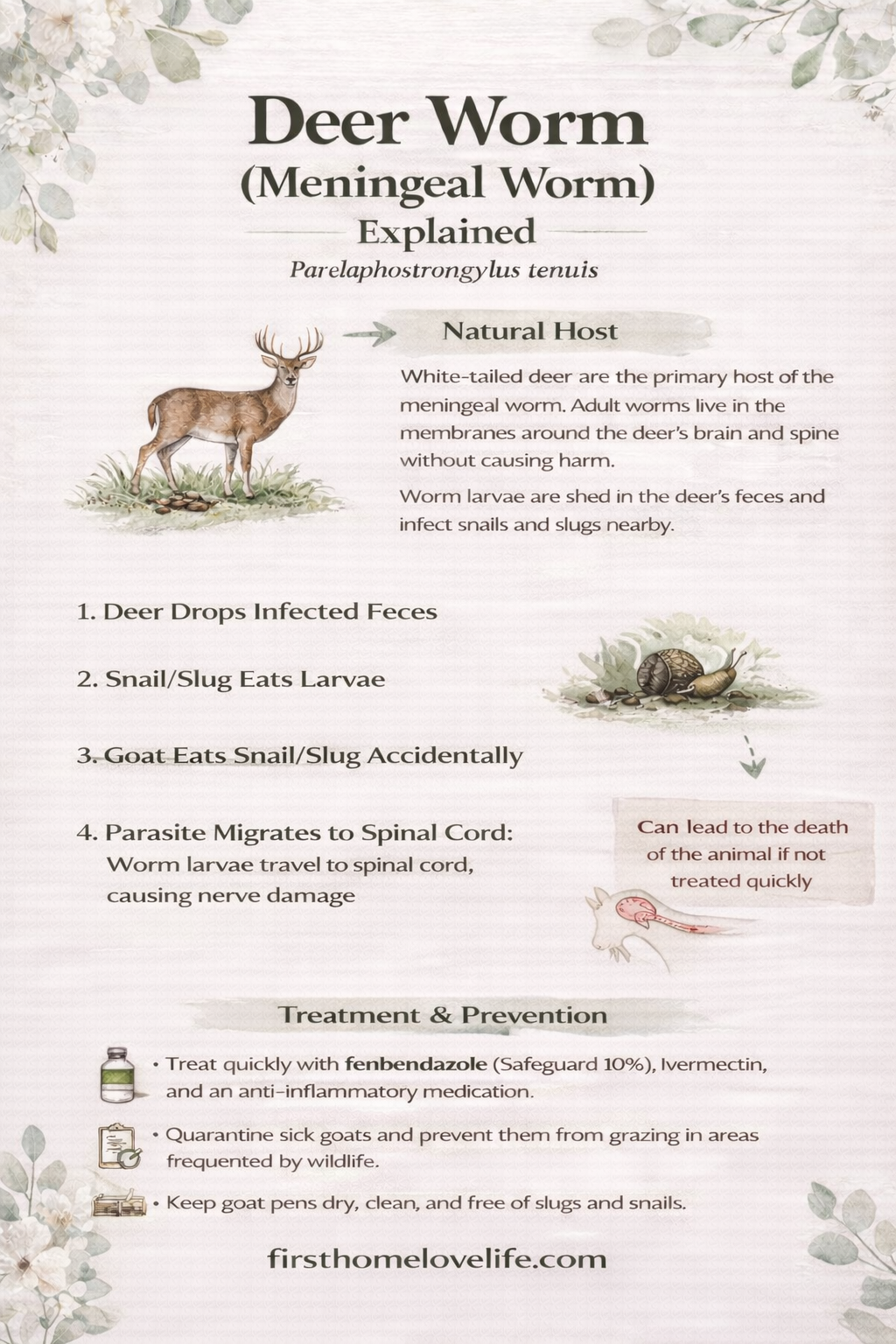
Meningeal worm is caused by a parasite called Parelaphostrongylus tenuis. It naturally lives in white-tailed deer without causing them serious harm. Deer are its normal host.
The problem starts when it leaves the deer.
The parasite’s larvae are shed in deer feces. Snails and slugs crawl over that manure and ingest the larvae. Those infected snails and slugs then end up on pasture, hay, or browse.
When goats — or other abnormal hosts like sheep, llamas, alpacas, and sometimes cattle — accidentally ingest an infected snail or slug while grazing, the parasite enters their body.
But here’s the devastating part:
Unlike deer, goats are not the correct host. The parasite doesn’t “know” where to go. Instead of completing its normal life cycle, it migrates into the spinal cord and brain, causing inflammation and neurological damage.
And once that damage starts, time matters.
How Goats Contract Deer Worm
If you live in an area with white-tailed deer (which many of us do), your goats are at risk. It doesn’t matter how clean your pasture looks.
Transmission typically happens when:
- Goats graze in areas frequented by deer
- Pastures are damp (snails and slugs thrive in moisture)
- Hay is stored on the ground
- Browsing happens along wooded edges
Here in Upstate New York, deer are everywhere. You can fence them out as best as possible, but realistically, they still pass through, especially at night.
You rarely see the snail or slug that caused it. It’s accidental. Invisible.
And by the time you see symptoms, the parasite has already migrated.
The First Signs I Missed
Looking back, I can see the early signs:
- Slight wobble in the hind end
- Occasional stumbling
- Difficulty walking in a straight line
- Weakness when turning
At first, I wondered if he’d slipped on ice. Maybe a muscle strain. Maybe he’d gotten pushed around by another buck.
But within days, the wobble became dragging. He struggled to rise. His once-powerful frame couldn’t coordinate itself.
When neurological symptoms show up in goats, deer worm has to be on the list.
The Reality of Treatment
We called our farm vet immediately. She’s incredibly experienced — not only does she work with livestock, she also serves as a veterinarian at a local zoo. She deals with exotic species, neurological cases, complex parasitology.
And even she told me something that stuck:
“With meningeal worm, the problem isn’t knowing what to do. It’s catching it before the damage is done.”
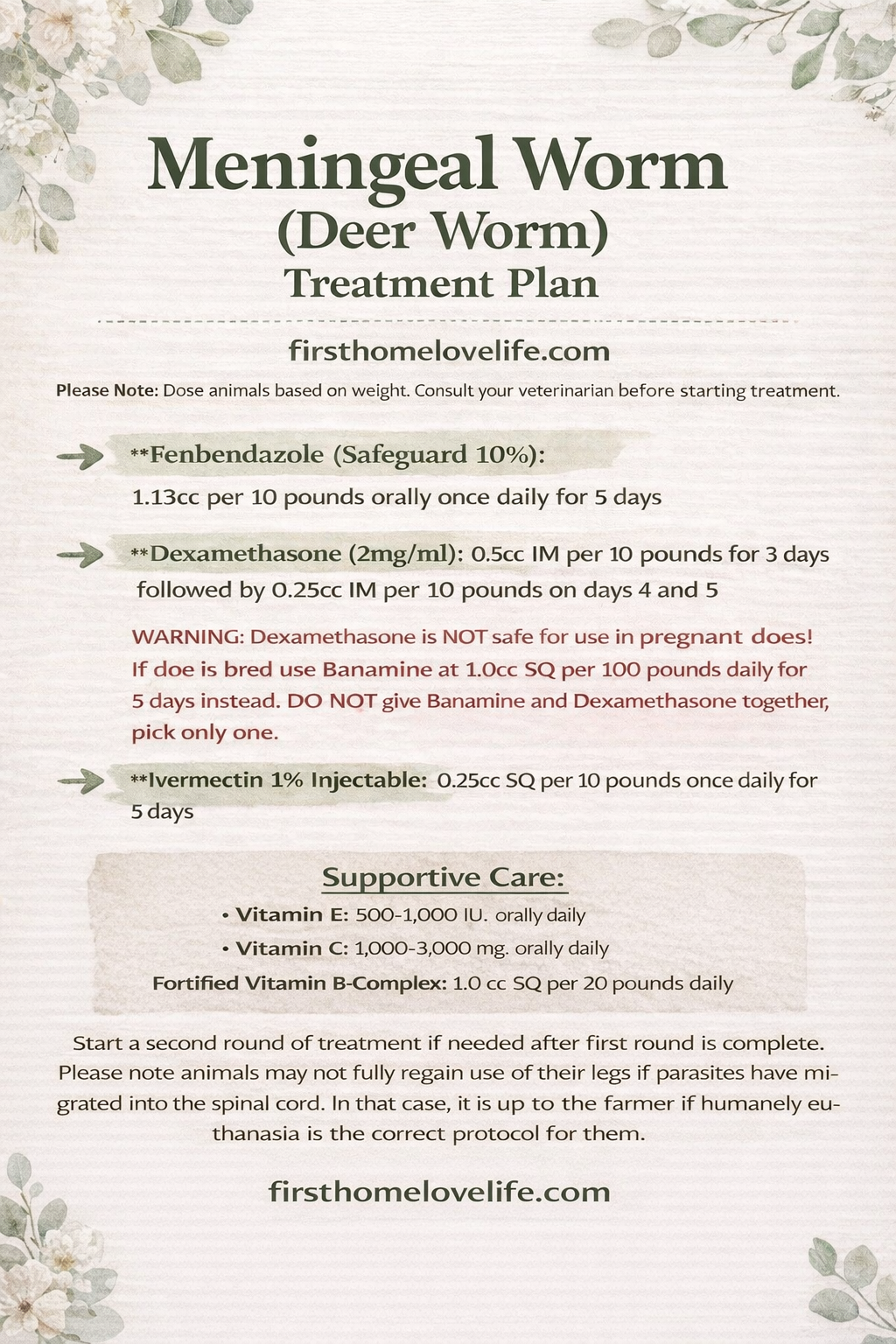
Treatment protocols typically involve:
- High doses of fenbendazole (to kill migrating larvae)
- Anti-inflammatories like dexamethasone or Banamine
- Ivermectin injections
- Supportive care (vitamins, physical therapy, slings for recumbent animals)
The goal isn’t just to kill the parasite. It’s to reduce the inflammation in the spinal cord as it dies. Because that inflammation is what causes paralysis.
But here’s the hard truth:
By the time symptoms are obvious, significant neurological damage may already be irreversible.
Even zoo animals — with immediate intervention, controlled environments, and advanced care — don’t always recover.
That reality was sobering.
The Downward Turn
We started treatment aggressively. We monitored him constantly. We lifted him. We repositioned him. We supported him.
There were moments when I thought he might rally. A stronger attempt to stand. A brighter eye. A flicker of hope.
But the spinal damage continued to reveal itself.
He could no longer rise without help. Then even standing with support became too much. His mind was still there. He still wanted to fight.
That was the hardest part.
Eventually, we had to make the call no farmer ever wants to make.
Losing a breeding buck isn’t just losing an animal. It’s losing genetics, future kids, years of planning, and a presence in the herd that can’t be replaced overnight.
Why Deer Worm Is So Frustrating
Meningeal worm is devastating because:
- There is no simple diagnostic test while the animal is alive. Diagnosis is based on symptoms and ruling out other causes.
- Symptoms mimic other neurological issues.
- Damage happens before outward signs are severe.
- Even early treatment doesn’t guarantee recovery.
And prevention isn’t foolproof.
Some farmers use monthly ivermectin injections during high-risk seasons. Others focus heavily on pasture management, deer deterrence, and minimizing wet grazing areas.
But there is no perfect shield.
What I Learned
I learned that neurological symptoms in goats should never be watched casually.
I learned that deer presence on your land is not harmless.
I learned that even highly trained veterinarians — even those trusted with zoo animals — can’t always outrun this parasite.
And I learned that sometimes, despite doing everything right, you still lose.
If You Suspect Meningeal Worm
Call your vet immediately. Don’t wait “one more day” to see if it improves.
The earlier treatment begins, the better the odds.
Watch for:
- Wobbling hind legs
- Knuckling or dragging hooves
- Head tilt
- Walking in circles
- Sudden weakness
- Inability to stand
Time is critical.
The Emotional Side of Farm Loss
There’s a quiet grief in farming that people outside this life don’t always see.
We raise animals with purpose — but also with care, intention, and relationship. My buck trusted me. He came when I called. He lowered his head for scratches.
And in the end, I could not save him.
But I can share what happened.
If telling this story helps another farmer act one day sooner… if it saves one goat… then his loss carries meaning beyond our fence line.
If you live in deer-heavy country, take meningeal worm seriously.
I wish I had understood how fast it can move.
And I hope you never have to stand where I stood last year.