Crockpot Marinara Sauce: How to Make, Freeze and Can It
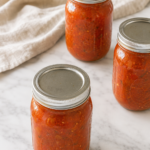
- Prep Time: 2 HOURS
- Cook Time: 3 HOURS
- Total Time: 5 hours
- Yield: Approximately 9 pints 1x
Ingredients
- 30 pounds fresh ripe tomatoes
- 1 cup chopped onion
- 5 garlic cloves, minced
- 1 cup chopped celery or green bell pepper
- 1 pound fresh mushrooms, sliced, optional
- ¼ cup vegetable oil
- 4½ teaspoons salt
- 2 teaspoons ground black pepper
- 2 tablespoons dried oregano
- ¼ cup minced parsley
- ¼ cup brown sugar
Instructions
Prepare the Tomatoes
- Wash the tomatoes thoroughly under cool running water.
- Working in batches, place the tomatoes in boiling water for 30 to 60 seconds, or until the skins begin to split.
- Immediately transfer the tomatoes to a large bowl of ice water.
- Slip off the skins, remove the cores and cut the tomatoes into quarters.
- Place the prepared tomatoes in a large stockpot. Bring them to a boil and cook uncovered for 20 minutes.
- Pass the cooked tomatoes through a food mill or sieve to remove the seeds and create a smooth tomato pulp.
Prepare the Marinara Sauce
- Heat the vegetable oil in a large skillet over medium heat.
- Add the measured onion, garlic, celery or green pepper and optional mushrooms. Sauté until the vegetables are tender.
- Combine the sautéed vegetables and prepared tomato pulp in a large stockpot.
- Add the salt, black pepper, oregano, parsley and brown sugar.
- Bring the mixture to a boil. Reduce the heat and simmer uncovered until the sauce reaches serving consistency and its volume has been reduced by nearly one-half.
- Stir frequently while the sauce reduces to prevent scorching.
Prepare the Pressure Canner
- Prepare the pressure canner according to the manufacturer’s directions.
- Wash the jars, lids and screw bands in hot, soapy water. Rinse thoroughly and keep the jars hot until ready to fill.
- Keep the marinara boiling hot while filling the jars.
Fill the Jars
- Ladle the hot marinara into hot pint or quart jars, leaving 1 inch of headspace.
- Run a bubble-removal tool around the inside of each jar. Adjust the headspace if necessary.
- Wipe the jar rims with a clean, damp cloth.
- Center the lids on the jars and apply the screw bands until fingertip-tight.
- Place the filled jars in the prepared pressure canner.
Process the Marinara
- Vent and operate the pressure canner according to the manufacturer’s instructions.
- Process pint jars for 20 minutes or quart jars for 25 minutes at the correct pressure for your canner and elevation.
- If the pressure drops below the required level during processing, return the canner to the correct pressure and restart the entire processing time.
- When the processing time is complete, turn off the heat and allow the canner to depressurize naturally. Do not force-cool the canner.
- Open the canner according to the manufacturer’s directions, tilting the lid away from your face.
- Transfer the jars upright to a towel-lined counter. Allow them to cool undisturbed for 12 to 24 hours.
- Remove the screw bands and check the seals. Refrigerate and promptly use any jars that did not seal.
- Label the sealed jars and store them without the screw bands in a cool, dry, dark location.
Pressure Settings
Dial-Gauge Pressure Canner
- 0 to 2,000 feet: 11 pounds
- 2,001 to 4,000 feet: 12 pounds
- 4,001 to 6,000 feet: 13 pounds
- 6,001 to 8,000 feet: 14 pounds
- Above 8,000 feet: 15 pounds
Weighted-Gauge Pressure Canner
- 0 to 1,000 feet: 10 pounds
- Above 1,000 feet: 15 pounds
Notes
Do not increase the amount of onion, garlic, celery, green pepper, mushrooms or oil.
The mushrooms may be omitted. The celery or green pepper may also be reduced or omitted, but do not use more than one cup total.
Do not add meat, cheese, cream, butter, flour, cornstarch, extra vegetables, tomato paste or additional oil before canning.
Do not substitute commercially canned tomatoes for the fresh tomatoes in this tested recipe.
Do not cook the sauce down beyond the nearly one-half reduction specified in the recipe. An excessively thick sauce may not heat evenly during processing.
This sauce must be processed in a pressure canner. It is not suitable for boiling-water canning.
Always confirm your elevation and follow the operating instructions provided with your pressure canner.
For the best quality, use properly sealed jars within one year.
Recipe Source: Adapted from the research-tested Spaghetti Sauce Without Meat recipe from the National Center for Home Food Preservation.
Equipment
- Pressure canner
- Large stockpot
- Large skillet
- Food mill or sieve
- Canning jars, lids and screw bands
- Jar lifter
- Canning funnel
- Bubble-removal tool
- Ladle
- Clean kitchen towels
Find it online: https://www.firsthomelovelife.com/perfect-crock-pot-marinara/